
Tracking Classes
What Is a Tracking Class?
A tracking class (shown as the Class field on a transaction) is a tag you can attach to a transaction to slice your reports along a dimension that is not a category, account, or fund. The most common use cases are:
- Ministries -- Tag every transaction touching the youth ministry, the worship team, or missions so you can group them together.
- Campuses or locations -- For multi-site churches, tag transactions per campus.
- Programs or events -- Track all spending for a summer camp, building campaign, or one-time conference.
- Departments -- Separate office-side spending from facility-side spending without creating duplicate categories.
Tracking classes complement (but do not replace) categories and funds. Where a category answers what type of expense was this? and a fund answers which restricted bucket of money paid for it?, a tracking class answers which ministry, campus, or program does this belong to?
Mode Requirements
The Class field is part of Full Accounting (Advanced) mode. It does not appear in Simple Checkbook mode -- Simple mode keeps the transaction form to the essentials (date, amount, account, category, fund).
You can switch between Simple Checkbook and Full Accounting at any time under Finances > Accounting > Settings (the Accounting Mode card at the top of the page). Switching only changes labels and which screens you see -- your financial data is never touched -- so any classes already applied to transactions are preserved if you move to Simple mode and back.
Tagging a Transaction
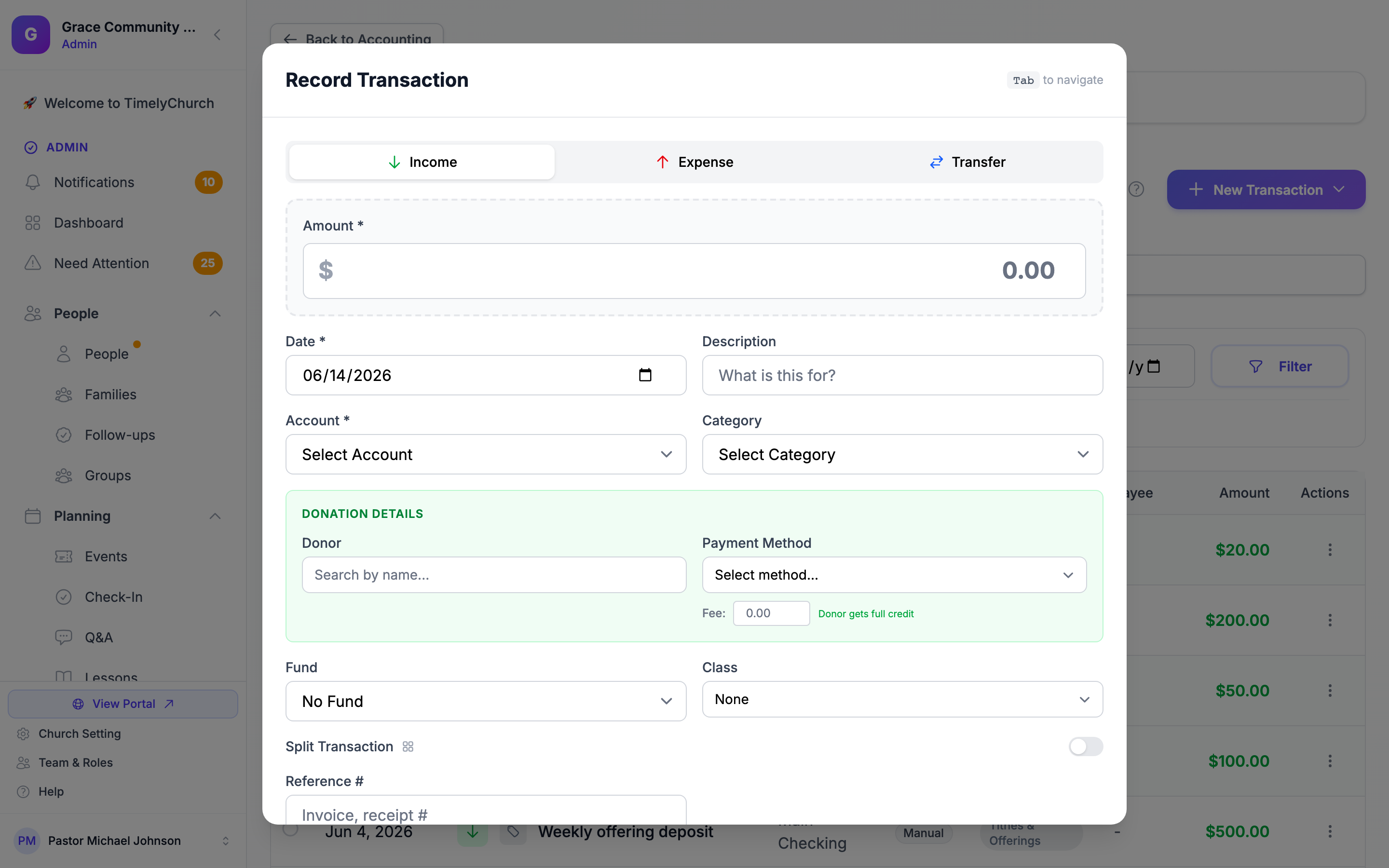
In Full Accounting mode, the Class field appears on the transaction form:
- On the Transactions page, click New Transaction and choose New Expense, New Income, or New Transfer. (All three open the same form, pre-set to that type.)
- Fill in the transaction as usual.
- In the Class dropdown -- shown next to Fund -- pick the class this transaction belongs to. Leaving it on None is always allowed; not every transaction needs a class.
- Save.
The same Class dropdown is available when you edit an existing transaction, so you can add or change the class later.
If you use Split Transaction to allocate one transaction across several categories, each split line is saved against the transaction's class as well.
For donations imported automatically from the Giving module, you can set the class later by editing the resulting income transaction and choosing a value in the Class dropdown.
Where Tracking Classes Come From
The classes that appear in the Class dropdown are the active classes set up for your church. If the dropdown only shows None, no classes have been created yet.
Note: Class setup is handled by TimelyChurch as part of your accounting configuration. If you need a new class added, renamed, or retired, contact support and we will set it up for you.
Most churches end up with somewhere between 5 and 25 classes. A class can be marked inactive to retire it without losing history -- inactive classes stop appearing in the Class dropdown but stay attached to the transactions that already use them.
Best Practices
Keep the list short. A handful of well-defined classes is more useful than dozens of overlapping ones. Aim for the smallest number that answers the questions your board actually asks.
Decide a tagging convention up front. "Tag every transaction" works for some churches; "tag only ministry-specific transactions, leave general overhead untagged" works for others. Pick a convention and document it.
Tracking class versus fund. Use a fund when donor restrictions or accounting rules say money must be kept separate. Use a tracking class when you only need to report on it as a slice. Many churches use both: e.g., the Building Fund (fund) might also be tagged with "Capital Campaign 2026" (class) to differentiate from prior campaigns held in the same fund.
Tracking class versus category. Categories are the chart-of-accounts dimension that flows into your Income Statement. Tracking classes are an orthogonal dimension. Use both. A single utility bill might be in category "Utilities" and tagged with class "Main Campus" -- both are useful, neither replaces the other.