
Importing Songs from Documents — Word, PDF and Scanned Sheets
Most churches already own their songs. They're in a binder of photocopies, in a Word file somebody typed years ago, in PDFs that arrived by email over the course of a decade. The only thing missing is a way to get them into your song library without retyping every chord by hand.
Import documents does that. Upload the files you already have — Word documents, PDFs, or a photo or scan of a printed sheet — and TimelyChurch reads each one and proposes a song: the title, the sections it found, and the chords placed above the words they belong to. You review the proposal, correct anything that's wrong, and save.
Available on the Growth and Pro plans. On the Starter plan the menu entry doesn't appear at all.
This is assisted, not automatic. TimelyChurch proposes; you decide. Nothing is added to your song library until you save it yourself, and you should read each song before you do.
What You Can Upload
| File types | PDF, Word (.docx), PNG, JPEG |
| How many | Up to 10 files at a time |
| How big | 20 MB per file |
A scan or a phone photo of a printed page is a supported input, not a fallback — though printed pages are harder to read than a document that was typed, and the review screen tells you when it's working from a scan.
Importing Your First Songs
-
Go to Worship → Songs.
-
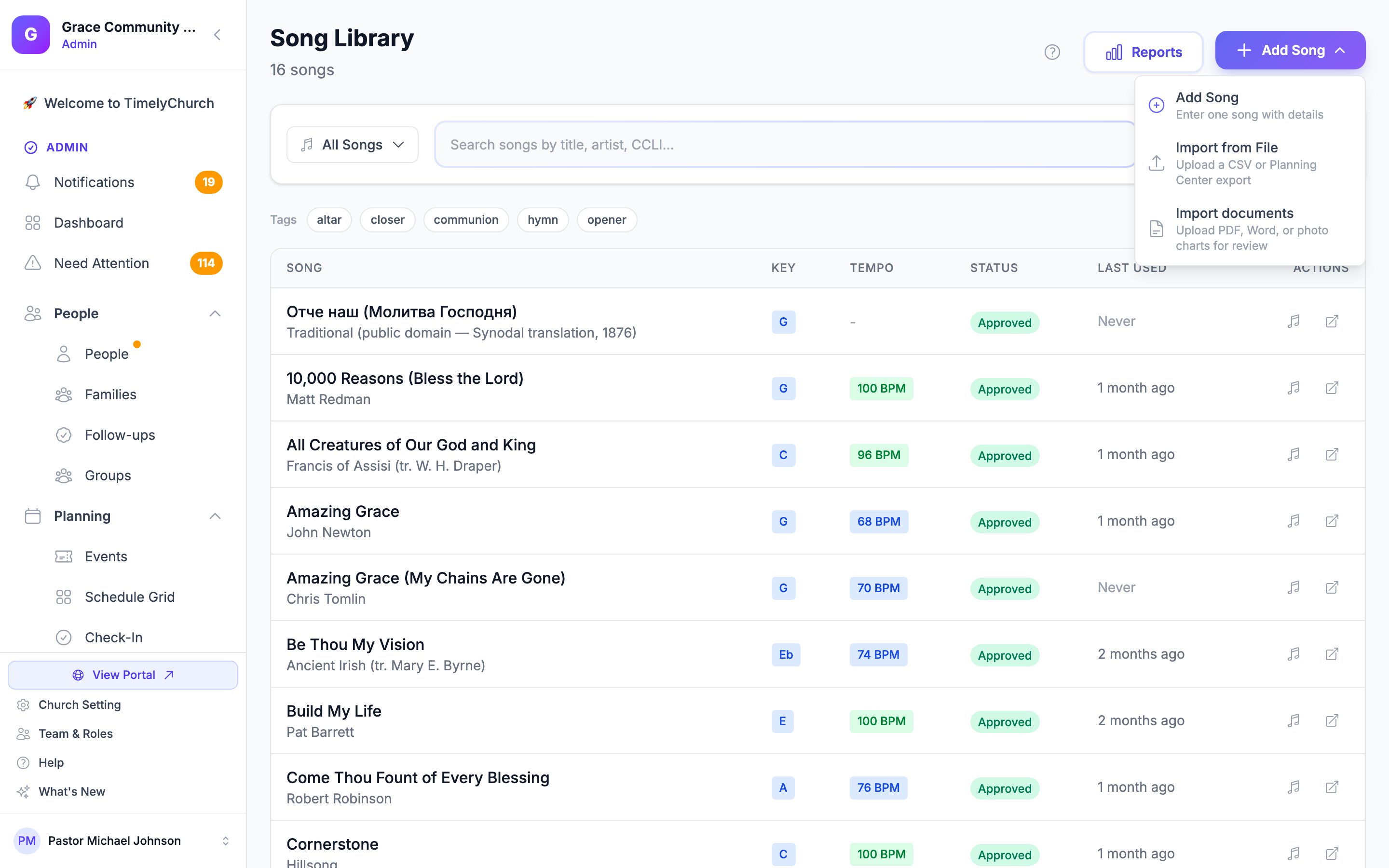
Click Add Song in the top-right corner to open its menu, then choose Import documents.
-
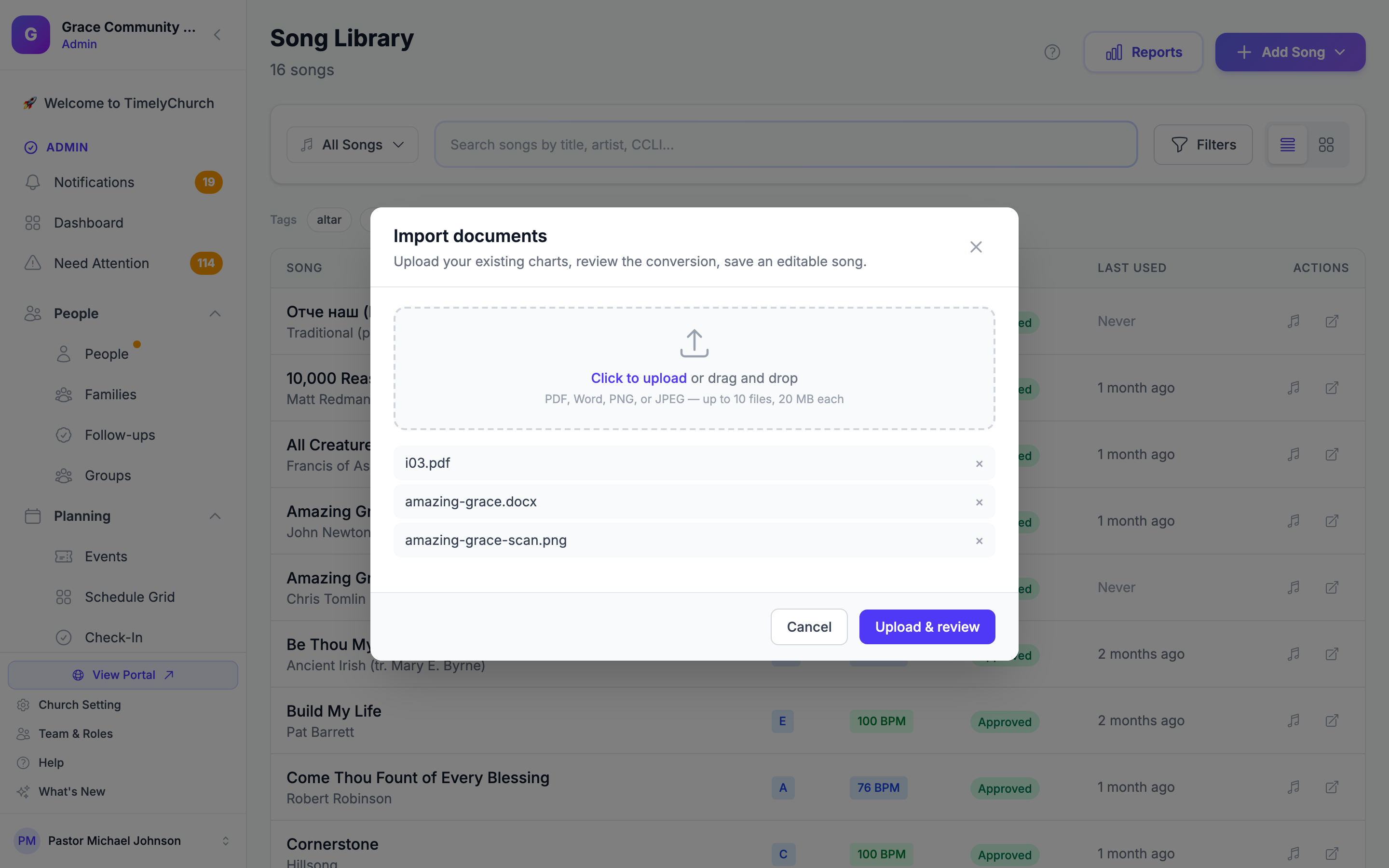
Drag your files onto the drop zone, or click it to pick them from your computer. The files you've chosen are listed underneath, and you can remove any of them with the × beside the name.
-
Click Upload & review.
-
Each file now shows its own state — Queued, then Extracting…, then Ready for review. This runs in the background, so you can leave the page and come back; you don't have to sit and watch it. A typical PDF is ready to look at in a few seconds, a Word file or a scan in a few more.
-
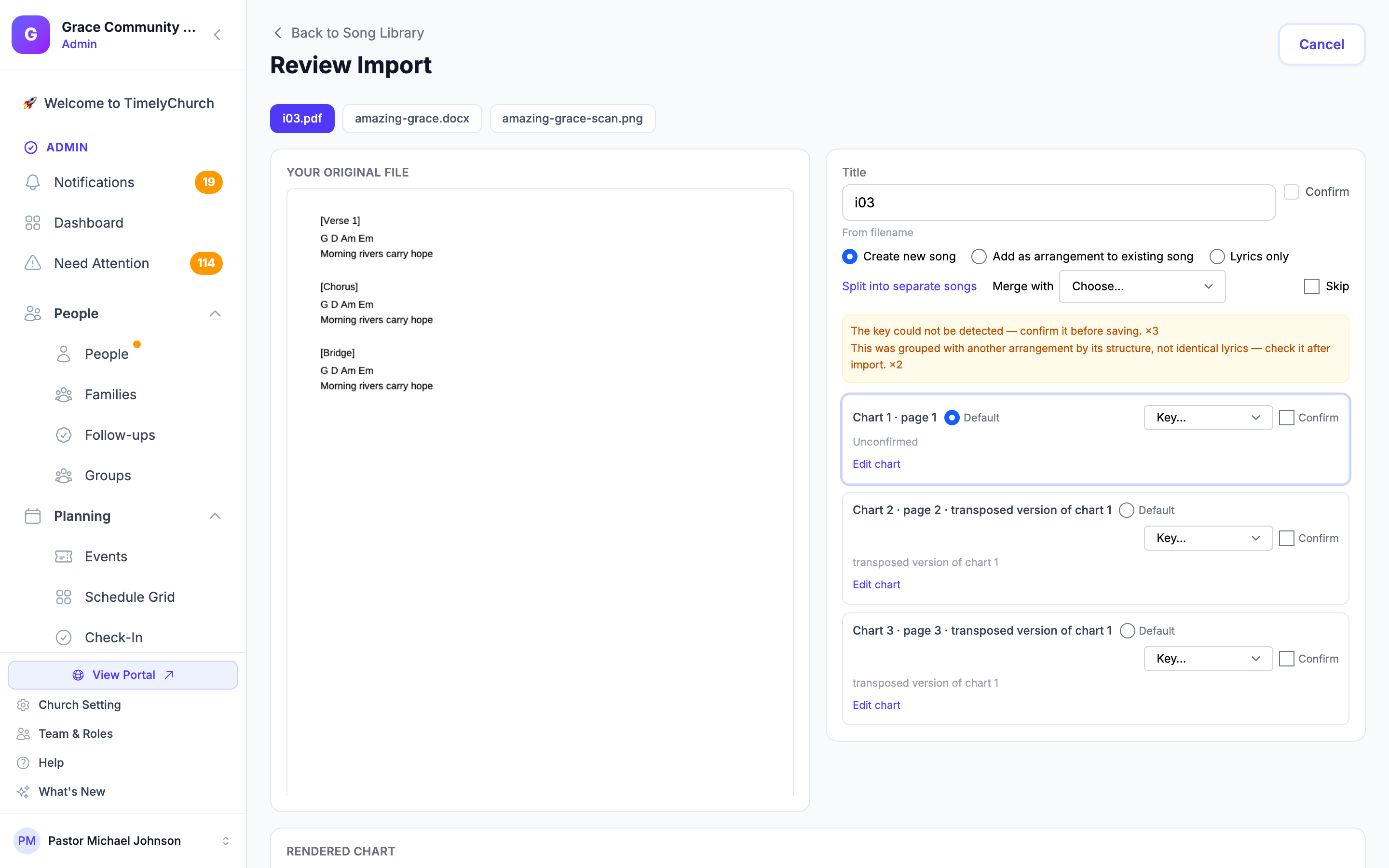
When a file is ready, the Review Import screen shows your original document on the left and the proposed song on the right. Read across, compare, and correct.
-
When everything looks right, click Save reviewed songs. This is the only action that adds anything to your library.
Reviewing a Proposed Song
Everything on the right-hand side is yours to change before you save.
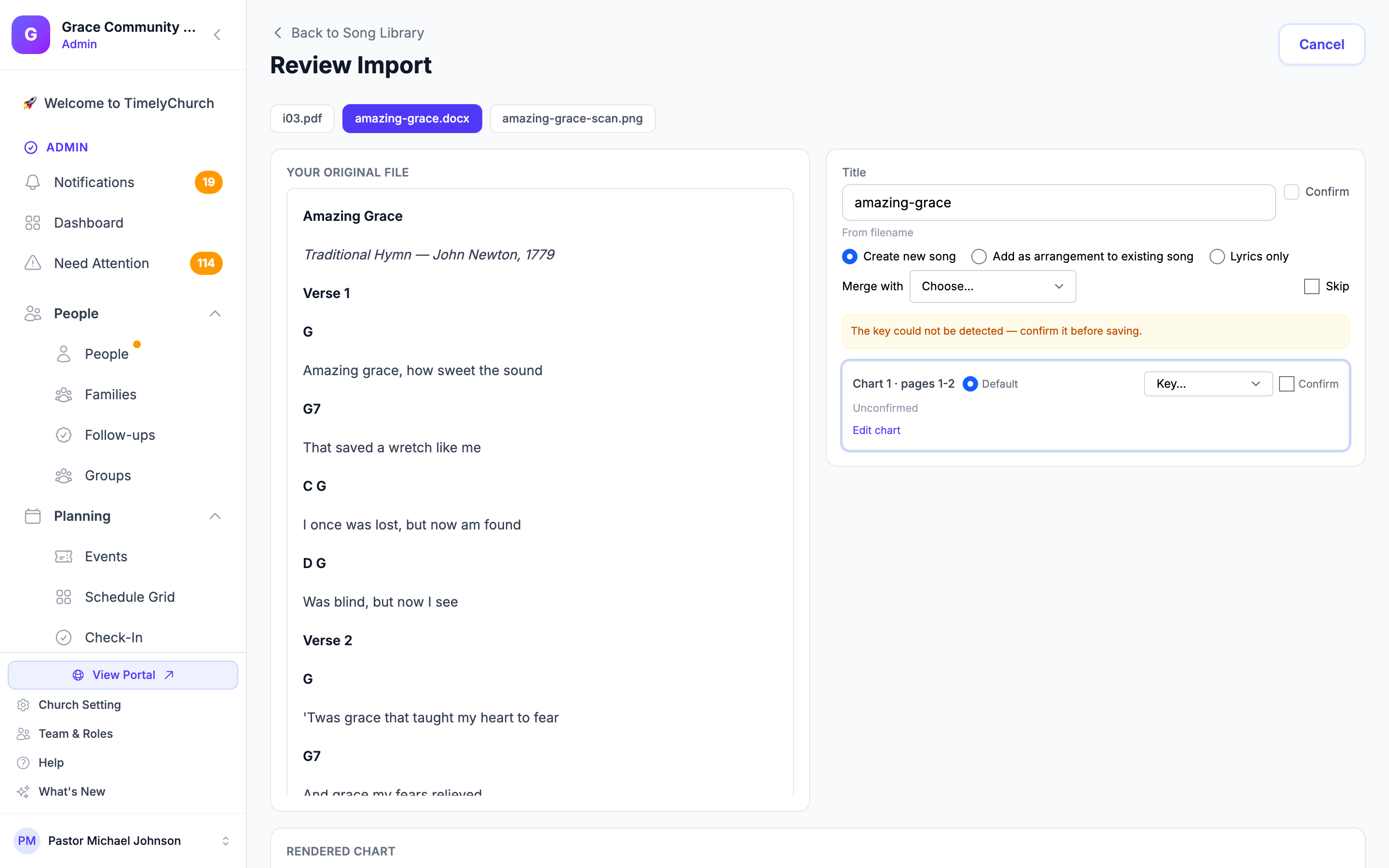
Title. Retype it if it's wrong, then tick Confirm. Underneath the field, a small line tells you where the title came from — whether it was written in the document, taken from the file name, or not confirmed at all.
What this song should become. Choose one:
- Create new song — a song that isn't in your library yet.
- Add as arrangement to existing song — search your library, pick the song, and this becomes another arrangement of it. Useful when the document is the same song in a different key.
- Lyrics only — keep the words, drop the chords.
Split into separate songs. If one document turned out to contain two songs, this separates them.
Merge with. If two of your uploaded files turned out to be the same song, merge one into the other.
Skip. Leave this one out entirely. It won't be saved.
Key. Confirm the key for the arrangement. If the key couldn't be read from the document, that song is listed in a checklist near the top and Save reviewed songs stays disabled until you've confirmed it.
Edit chart. Opens the chart for editing so you can fix a chord, a section label or a line of lyrics by hand, right there. Click Done editing when you've finished.
When TimelyChurch Isn't Sure
Anything the reading was uncertain about is shown as a plain amber note on that song, in words you can act on. You'll see things like:
- This looks like a scanned document — accuracy may be lower.
- Scanned-text recognition had low confidence here — check it after import.
- This document contains a table — its content may not have imported as expected.
- A chord written as H (the German/Russian B) was read as B.
- The key could not be detected — confirm it before saving.
When the same note applies several times, it appears once with a count beside it rather than repeating down the page.
If one of your files couldn't be used at all, it's named at the top of the screen along with the reason, so you don't have to click through each file to find out what happened to it.
After You Save
You'll see Import complete, with each result named — New draft song for a song that's new to your library, or Arrangement added for one attached to a song you already had — and a link back to the song library.
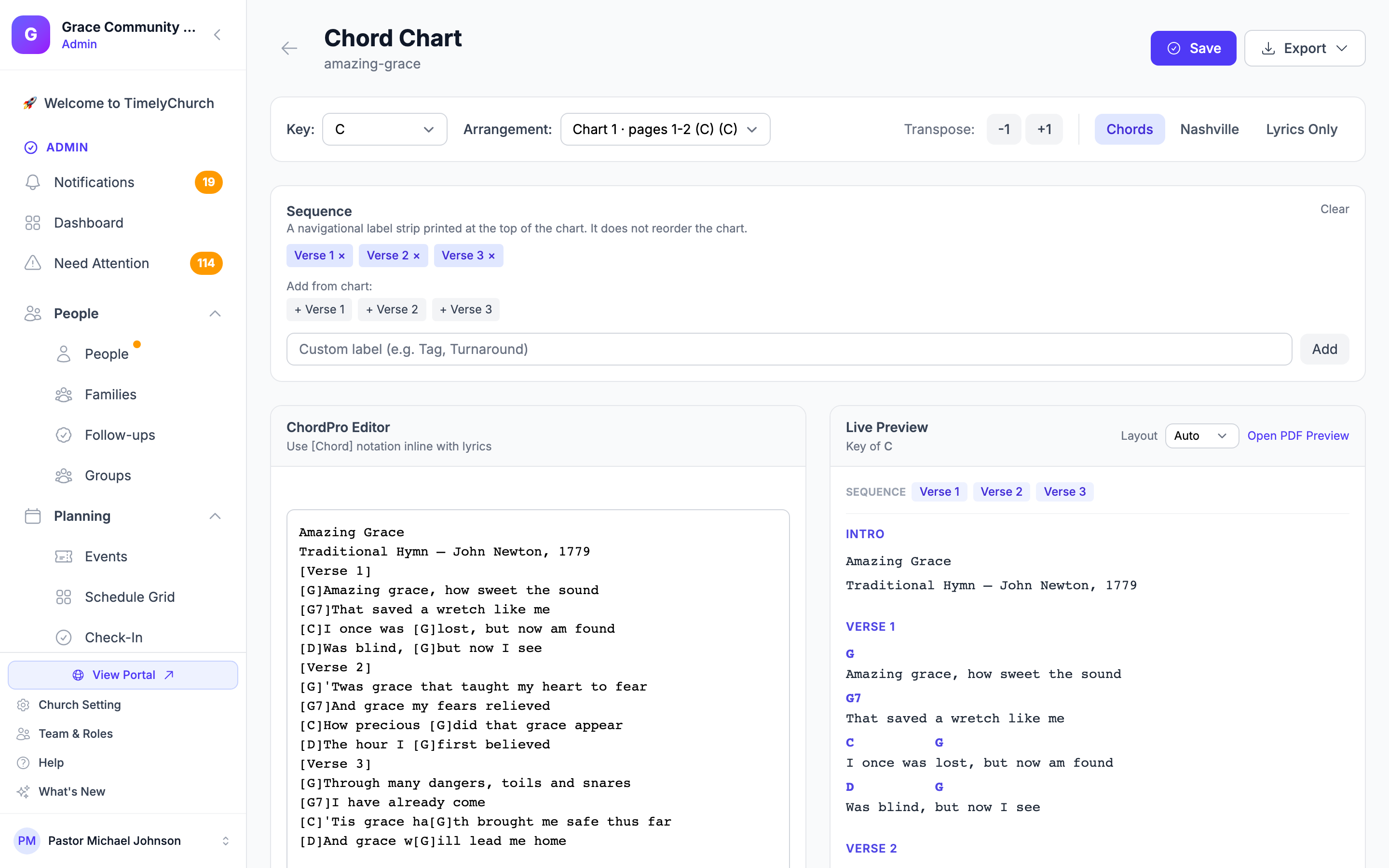
What you get is an ordinary TimelyChurch song. It transposes, it goes into setlists, it appears on My Stand, it can be translated, and it exports as a chart or as slides — exactly like a song you typed in yourself. A new song arrives as a draft, so review it and change its status when you're happy with it.
Tips
- Start small. Import five songs before you import fifty. You'll learn quickly how your particular documents read, and what you need to check.
- Read every song before saving. The side-by-side layout exists for exactly that. A clean Word file and a grey photocopy are not the same job, and no accuracy figure would tell you which one you're holding.
- Scans need the closest look. When the page tells you it's working from a scan, read that song twice — especially the chords.
- Don't stare at the progress screen. Extraction runs in the background. Start it, do something else, come back.
- Finish the review in one sitting. A review that's left alone eventually expires, and nothing is added. Your files are still on your computer, so you can simply upload them again.
- Ten files per batch. A large library comes across in several batches rather than one go.
- Use "Add as arrangement" for the same song in another key. It keeps one song in your library with several arrangements, instead of several near-identical songs.
What Happens to Your Document
Your file is processed and the temporary copy is removed. What remains is the song you reviewed and saved, in your church's song library, exactly like every other song in it.
Related Articles
- Song Library — where imported songs land, and everything you can do with them afterwards
- Chord Charts and Key Transposition — editing the chart you just imported, and changing its key
- Song Arrangements — what "Add as arrangement to existing song" creates
- Adding a Translation to a Song — adding another language to an imported song
- Exporting Charts and Slides — getting the imported song back out again