
Simple vs. Advanced Accounting Mode
Overview
TimelyChurch's accounting can run in one of two modes:
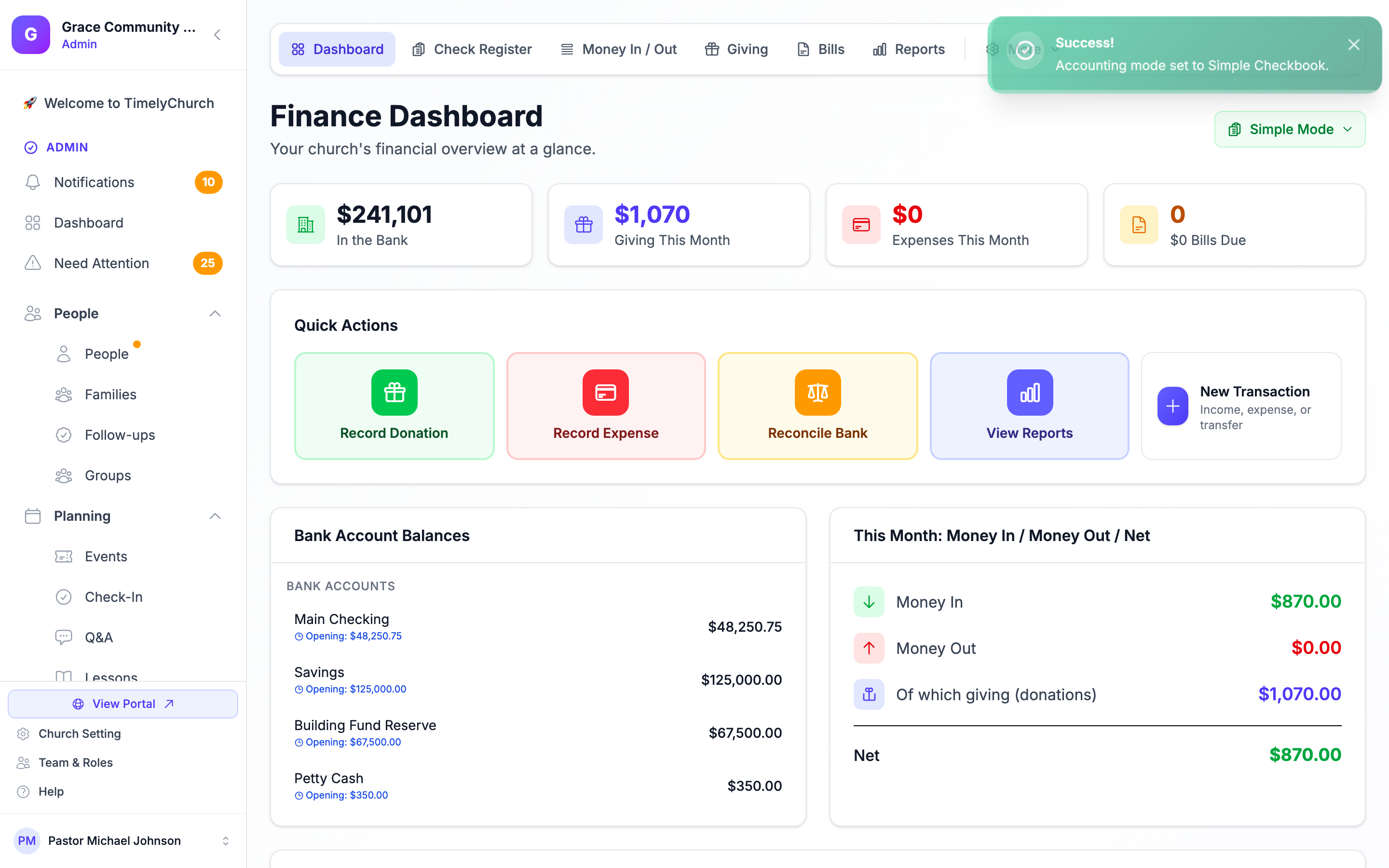
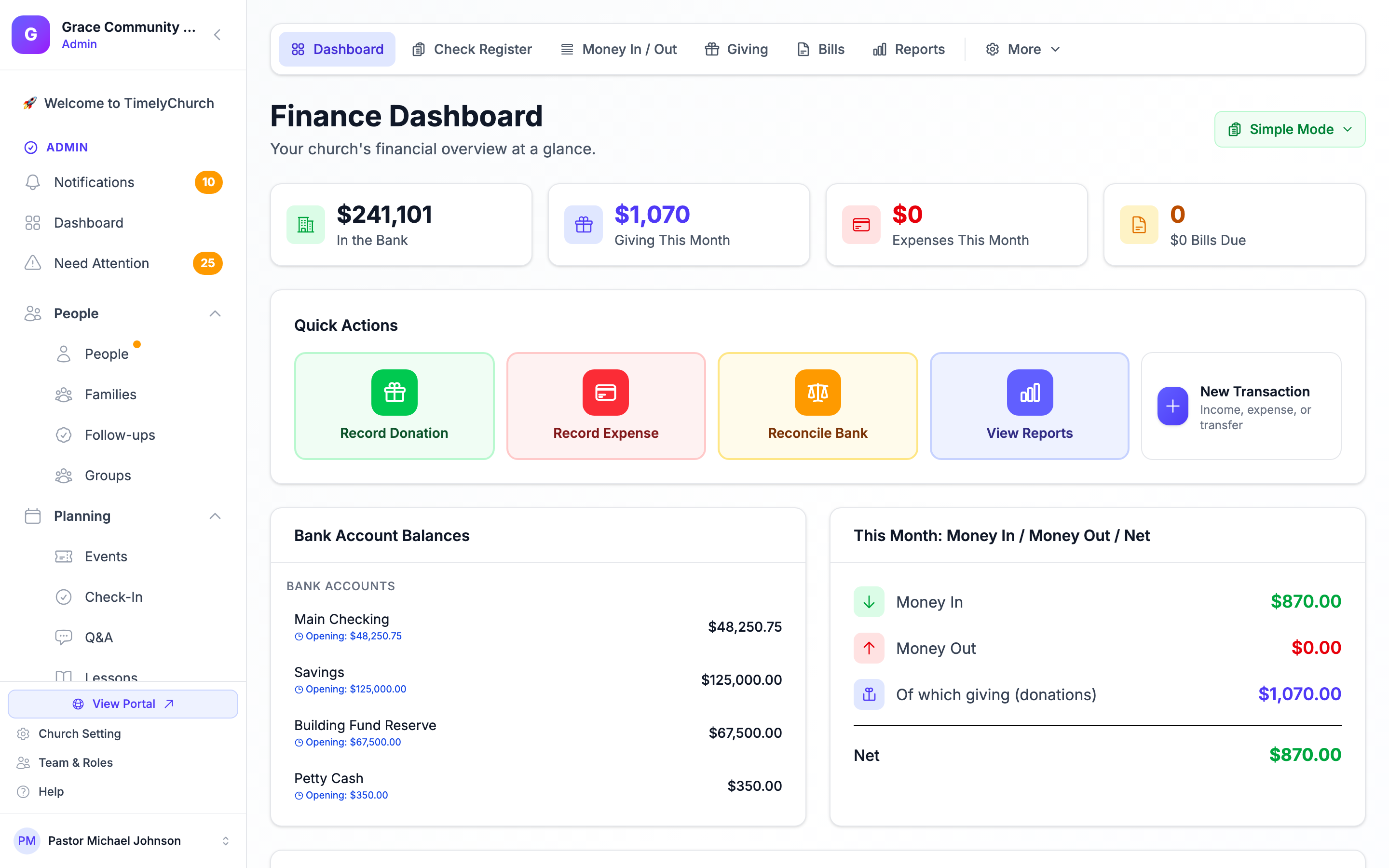
- Simple Checkbook -- A streamlined view designed for small churches and volunteer treasurers. The accounting tab bar shows the Dashboard, Check Register, Money In / Out, Giving, Bills, and Reports, and the everyday screens are relabeled in plain language (for example, Transactions becomes Money In / Out and Income / Expense become Money In / Money Out). A few power-user screens (Chart of Accounts, Budgets, Journal Entries) are hidden to reduce clutter.
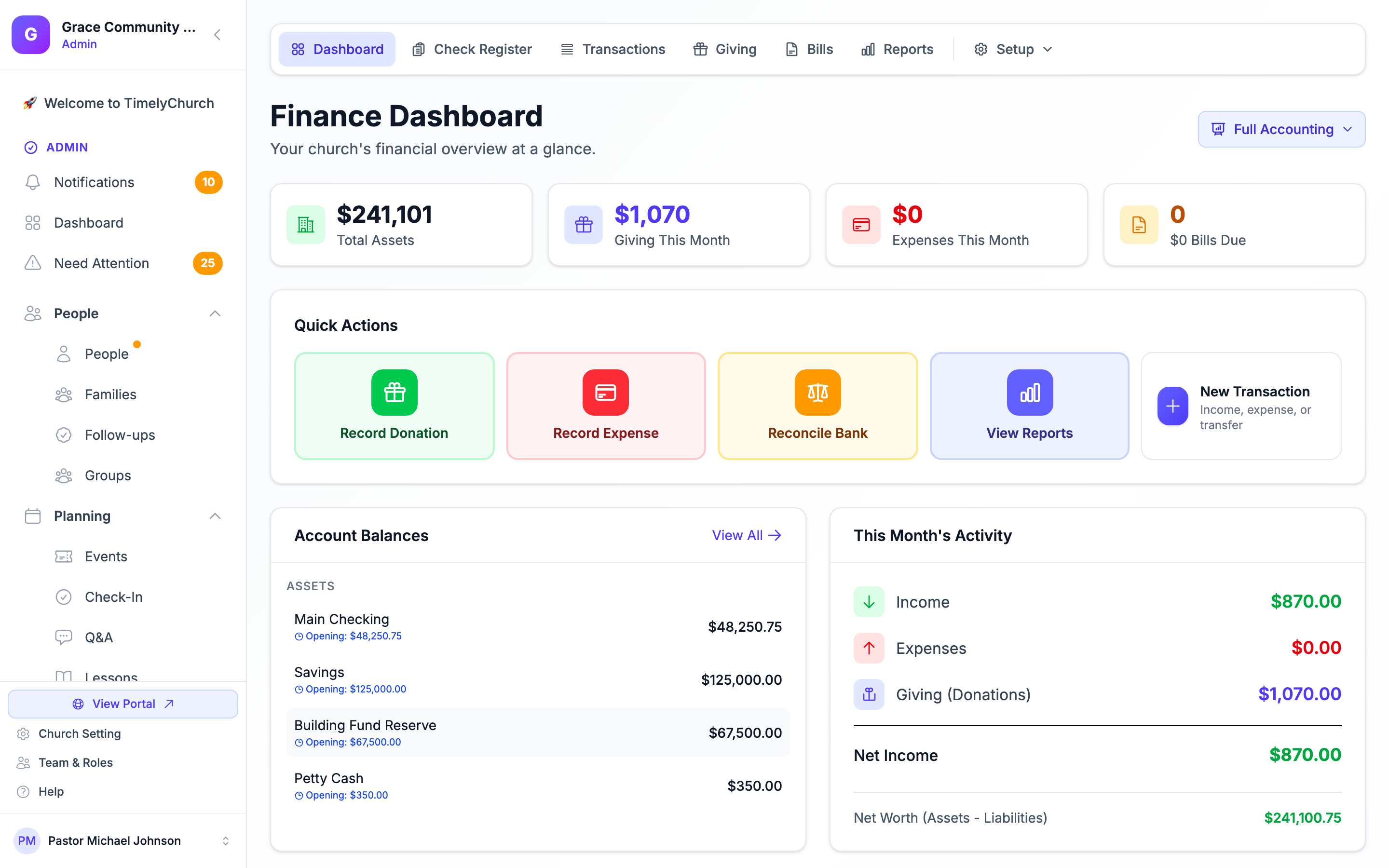
- Full Accounting (Advanced) -- Every accounting feature is exposed, with standard accounting terminology: Chart of Accounts, Categories, Payees, Budgets, Reconciliation, Journal Entries, Trial Balance, General Ledger, Audit Log, and the full Reports suite.
Both modes operate on the same underlying data. Switching modes does not migrate, copy, or delete anything -- it only changes which screens are visible in the navigation and how some of them are labeled. A transaction recorded in Simple mode is the same transaction in Full Accounting mode; only the wording on the screen differs.
Which Mode Should You Use?
| Use Simple Checkbook if... | Use Full Accounting if... |
|---|---|
| You have a single-person finance role (one treasurer) | You have a finance committee or multiple staff in the books |
| You think of finances as "the church checkbook" | You think in terms of debit/credit, asset/liability, accrual |
| You report cash-in / cash-out, not full statements | You produce Balance Sheets and Income Statements |
| Annual giving is below the threshold for an audit | Your bylaws or insurer require formal financial reports |
| You don't run formal annual budgets | You set, track, and report on a budget each year |
| You have fewer than ~5 bank-account-touching transactions per week | You have meaningful transaction volume across multiple accounts |
There is no "wrong" answer. Many churches start in Simple mode for the first year or two, then switch to Full Accounting when their finance team grows or when the board asks for more detailed reporting.
First-Time Setup
The first time you open Accounting on a new church, a short setup wizard asks who handles the books and picks a mode for you based on your answer. You can change the mode any time afterward (see "Switching Modes" below), so this first choice is not permanent.
What's Visible in Each Mode
In both modes the tab bar across the top of every accounting page shows the same core tabs:
- Dashboard
- Check Register
- Money In / Out (this tab is labeled Transactions in Full Accounting mode)
- Giving
- Bills
- Reports
The difference is the dropdown at the end of the tab bar:
- In Simple Checkbook mode it is labeled More ▾.
- In Full Accounting mode it is labeled Setup ▾.
Simple Checkbook Mode
The More ▾ dropdown exposes the screens a volunteer treasurer is most likely to need:
- Categories
- Payees
- Reconciliation
- Trial Balance
- General Ledger
- Audit Log
Hidden in Simple mode (these are Full-Accounting concepts):
- Chart of Accounts
- Budgets
- Journal Entries
Full Accounting (Advanced) Mode
The Setup ▾ dropdown exposes the full set of accounting screens:
- Chart of Accounts -- Full account hierarchy across the five accounting types.
- Categories -- Income and expense categories with sub-categories.
- Payees -- Vendor directory with 1099 tracking.
- Budgets -- Annual / quarterly / monthly budgets with variance reporting.
- Reconciliation -- The bank reconciliation workflow.
- Journal Entries -- Manual double-entry postings for CPA-style adjustments.
- Trial Balance -- A balance snapshot across all accounts.
- General Ledger -- A per-account drill-down of every posting.
- Audit Log -- A record of who changed what, and when.
Full Accounting also unlocks the complete Reports suite, including the Balance Sheet and Budget vs. Actual (see "Reports" below).
How Labels Change in Simple Mode
Simple mode keeps the same screens but relabels them in plainer language. The data is identical -- only the wording differs. A few examples:
| In Full Accounting | In Simple Checkbook |
|---|---|
| Transactions | Money In / Out |
| Income | Money In |
| Expense | Money Out |
| Income Statement | Money In vs Money Out |
| Opening Balances | Starting Balances |
Reports
Reports run on the same data in both modes; Simple mode simply shows a focused set and renames a couple of them.
- Simple Checkbook highlights the Treasurer's Report (a one-page monthly summary), plus Money In vs Money Out (the Income Statement), Giving Statements, and the 1099 Report. The Balance Sheet and Budget vs. Actual are hidden as they tend to confuse volunteer treasurers.
- Full Accounting adds the Balance Sheet and Budget vs. Actual on top of everything above.
Switching modes does not change the data inside any report, and historical reports keep the same figures regardless of mode.
Switching Modes
You can switch modes from either of two places.
From the Finance Dashboard:
- Go to Finances > Accounting.
- In the page header you'll see a button labeled either Simple Mode (green) or Full Accounting (indigo) depending on your current mode.
- Click the button to open the mode menu. You'll see two options summarizing what each mode includes.
- Click the mode you want and it takes effect immediately.
From Settings:
- Open Reports & Setup > Settings (or Settings under the dropdown) and find the Accounting Mode card.
- Choose Simple Checkbook or Full Accounting.
- Click Save Accounting Mode.
Behind the scenes, switching updates your church's stored accounting-mode preference. The page confirms the new mode with a brief success message.
Note: The switch takes effect immediately and applies to everyone in your church -- it is a church-wide setting, not a per-user preference. If your treasurer prefers Simple but the rest of the staff need Advanced, leave the church in Advanced and let the treasurer ignore the items they don't use.
What Happens When You Switch
Switching modes is non-destructive. Specifically:
- No data is migrated, copied, deleted, or transformed. Every transaction, account, payee, budget, and reconciliation stays exactly where it was.
- Hidden screens still hold their data. Switching from Advanced to Simple hides the Budgets page from navigation but does not delete any budgets. Switching back makes it visible again, untouched.
- Automation keeps running. Auto-posted recurring transactions, donation auto-posting, recurring bill generation, and Stripe fee auto-recording all continue regardless of mode.
- Reconciliation locks remain. A period reconciled while in Advanced mode is still locked when you switch to Simple, and vice versa.
You can switch back and forth as needed without consequence.
When to Switch From Simple to Advanced
Common signals it's time to upgrade:
- Your board asks for a Balance Sheet, an Income Statement, or category-level reports the Check Register can't produce.
- You start operating with multiple bank accounts and need formal monthly reconciliation.
- You set a formal annual budget for the first time.
- You hire a paid bookkeeper or treasurer who is used to standard accounting workflows.
- You acquire restricted funds (designated giving) that need to be tracked separately.
When to Switch From Advanced to Simple
Less common, but valid scenarios:
- A church plant is new and the volunteer treasurer is overwhelmed by the full feature set.
- You inherited an Advanced setup but the church has scaled down.
- You temporarily want to give a less-experienced volunteer treasurer a streamlined view.
In all of these, remember that the data is preserved -- you can always switch back.
Best Practices
Pick one mode and stick with it for a fiscal year. Switching mid-year is harmless but can confuse your staff and make the audit trail less clear. If you decide to upgrade to Advanced, do it at the start of a new fiscal year, ideally right after a year-end close.
Train on the mode you're using. If you're in Simple mode, don't worry about training new volunteers on the Chart of Accounts or Journal Entries -- they'll never see those screens. If you're in Advanced, walk them through the full workflow.
The reports in Simple mode are a subset, not a different format. Reports produced in Simple mode pull from the same data as the equivalent reports in Advanced mode. Switching modes changes some labels (for example, "Income Statement" becomes "Money In vs Money Out") but does not change the figures, and historical reports keep the same numbers.