
Song Arrangements
A Song Arrangement is a named variation of a song with its own key, tempo, chord chart, and supporting attachments. Arrangements let you keep a single canonical song record while still tracking that "Acoustic" is in G at 72 BPM, "Full Band" is in A at 88 BPM, and "Christmas Version" replaces the bridge with an instrumental. This article covers when to use arrangements, how to manage them, and how arrangements interact with chord charts, attachments, and service plans.
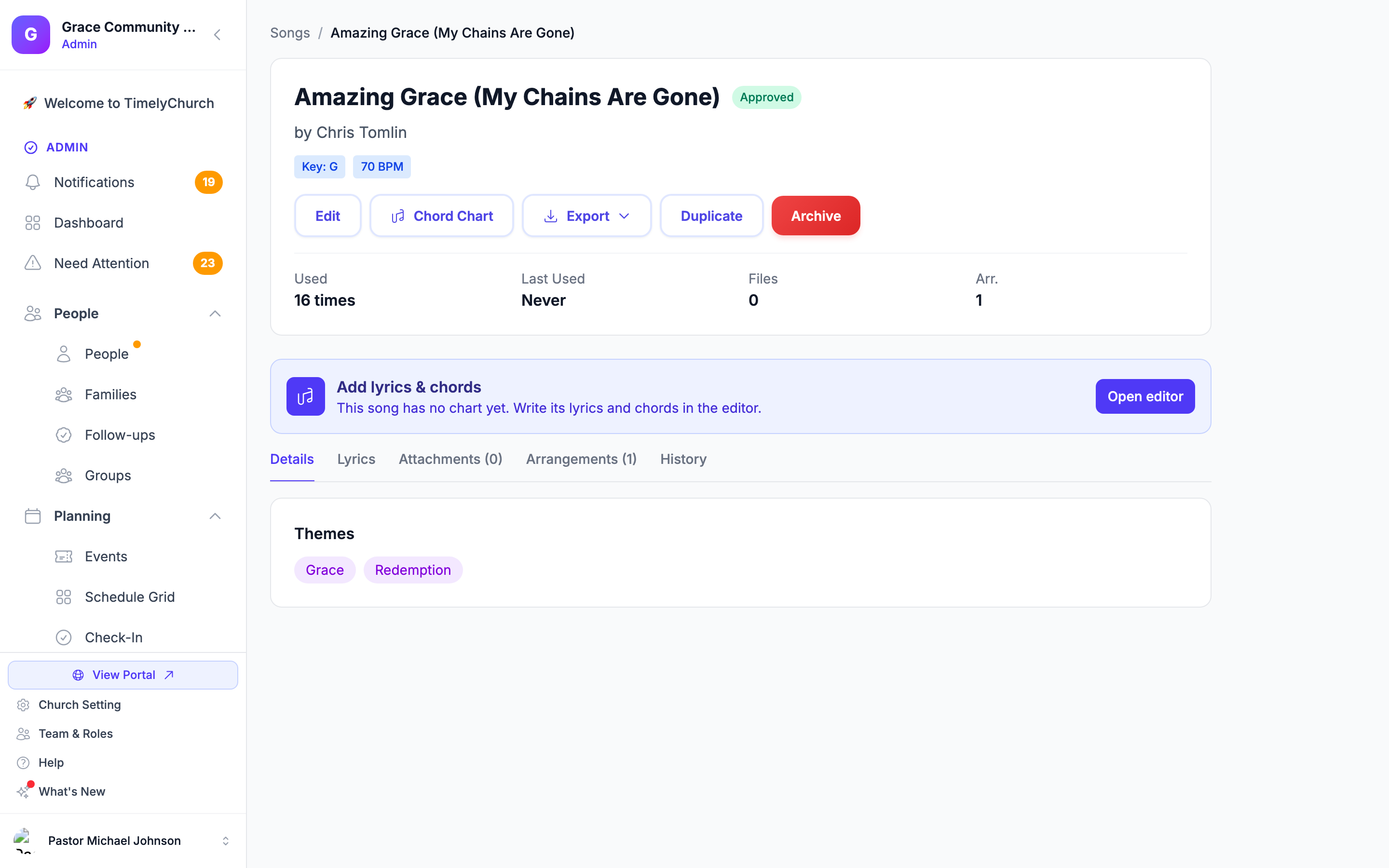
When to Use an Arrangement
Add an arrangement when the same song is performed in noticeably different ways and you want to preserve those variations as first-class records. Common uses:
- Different keys for different vocalists -- A male leader sings "Amazing Grace" in G; a female leader sings it in C. Two arrangements, same song.
- Acoustic vs. full-band -- Stripped-down rehearsal vs. Sunday morning.
- Seasonal versions -- Standard arrangement during the year, holiday remix in December.
- Cover songs from different artists -- Same hymn, two distinct band charts (e.g., the Hillsong arrangement vs. the original 1772 melody).
If the difference is just a one-time note ("we are going to skip verse 2 this Sunday"), prefer the notes field on a service-order item instead of creating a permanent arrangement.
Anatomy of an Arrangement
Each arrangement carries these fields:
| Field | Description |
|---|---|
| Name | Required label, e.g., "Acoustic", "Full Band", "Christmas". |
| Key | Musical key used for this arrangement. Falls back to the song's default key when blank. |
| BPM | Tempo in beats per minute (20-300). |
| Duration | Length in seconds. Used by service-plan timing calculations when this arrangement is selected. |
| Notes | Internal notes for the worship team. |
| Is Default | Whether this is the song's default arrangement. Exactly one arrangement per song is the default at any time. |
| Chord Chart | A chord chart stored on the arrangement (separate from the song's own chord chart). |
| Attachments | A file (chord chart PDF, lead sheet, audio reference) can be linked to a specific arrangement. |
The first arrangement you create is automatically marked default. When you mark another arrangement as default, the previous default is unset at the same time -- there is always exactly one default.
Adding an Arrangement
- Open a song from the Song Library.
- Click the Arrangements tab.
- Click Add Arrangement.
- Fill in the form:
- Name (required)
- Key (optional)
- BPM (optional, 20-300)
- Duration in seconds (optional)
- Notes (optional)
- Is Default (checkbox)
- Click Save.
The system creates the arrangement, optionally promotes it to the default, and returns you to the song detail page.
Editing an Arrangement
From the Arrangements tab, click an arrangement's Edit action. You can update every field above. If you uncheck "Is Default" on the current default, the system does not automatically promote another arrangement -- you can have a song with no default arrangement (in which case the song's own key/BPM/chord chart are used as the fallback). To switch defaults cleanly, edit the arrangement you want as the new default and check "Is Default"; the old default will be unset.
Deleting an Arrangement
From the Arrangements tab, click an arrangement's Delete action. Deletion:
- Removes the arrangement record.
- Removes every attachment linked to that arrangement (the underlying files are deleted as well).
- If the deleted arrangement was the default, the system promotes the song's first remaining arrangement to default automatically. If no arrangements remain, the song falls back to its own key, BPM, and chord chart.
The action cannot be undone, so confirm carefully.
Arrangement-Specific Chord Charts
The Chord Chart Editor includes an Arrangement dropdown in its toolbar. Each arrangement can carry its own chord-chart content, completely independent of the song's own chord chart and other arrangements'. When an arrangement is selected:
- Saving writes to the arrangement's chord chart (not the song's own chord chart).
- Transposing reads from the arrangement's chord chart first, then falls back to the song's chord chart if the arrangement is empty.
- Nashville mode computes numbers relative to the arrangement's key (or the song's default key if the arrangement has none).
- PDF export uses the arrangement's content and key.
This lets you keep wildly different chord charts for the same song -- a standard four-chord version on the song, a complex jazz reharmonization on an arrangement -- without conflict.
Arrangement Attachments
When you upload a file from the Attachments tab, you can optionally select an arrangement to scope it to. Attachments without an arrangement are visible on every arrangement; attachments scoped to a specific arrangement only appear when that arrangement is selected. This is useful for arrangement-specific reference recordings, lead sheets, or guitar-tab PDFs.
When an arrangement is deleted, its scoped attachments go with it. Attachments scoped to the song (not an arrangement) survive arrangement deletions.
An arrangement-scoped audio recording can be marked as that arrangement's reference recording and, on the Pro plan, analyzed for BPM/key/time signature the same way a song-level recording can -- useful when your "Acoustic" and "Full Band" arrangements were recorded at genuinely different tempos. See Analyze a Song's Key, BPM & Time Signature.
Using an Arrangement in a Service Plan
When you add a Song-type item to a service order, the Add Song dialog includes an Arrangement dropdown that lists every arrangement on the song plus a "(use song default)" option. Picking an arrangement:
- Saves the chosen arrangement on the service-order item.
- Pulls the arrangement's key, BPM, and duration into the item's defaults (which you can still override per-item).
- Causes the Worship Team Shared Setlist to display the arrangement's chord chart instead of the song's main chord chart.
If you later change a service order's selected arrangement, the change now flows through to any already-shared setlists automatically -- the shared link stays the same and your team sees the new arrangement within seconds. (In earlier versions you had to delete and re-create the shared setlist to push the change; that step is no longer required.)
Duplicating Arrangements
When you duplicate a song (Song detail page -> Duplicate), the system replicates every arrangement onto the new song. This is the cleanest way to spin off a deeply customized version of a song while preserving every variation you have built up. The duplicate's status is reset to Draft and its usage history is cleared, but arrangement-level chord charts and attachments come over intact.
Permissions
Adding, updating, and deleting arrangements all use the Services module permission. There is no separate "manage arrangements" permission -- if a user can edit a song, they can edit its arrangements.
Related Articles
- Song Library
- Chord Charts and Key Transposition
- Service Orders (Service Plans)
- Building Setlists
- Worship Team View
- Worship Overview
- Analyze a Song's Key, BPM & Time Signature
Last updated: August 5, 2026