
Duplicate Detection and Merge
Over time, duplicate person records can appear in your directory -- from importing data, different staff members adding the same person, or someone filling out a form with a slightly different name. TimelyChurch helps you find these duplicates, compare them side by side, and merge them into a single clean record without losing any data.
Why Duplicates Happen
- Multiple imports -- The same person appears in CSV files from different sources.
- Variant names -- "Bob Smith" and "Robert Smith" are entered as separate records.
- Typos -- "Jonh" vs. "John" or different email addresses for the same person.
- Form submissions -- A visitor fills out a connection card, and a staff member also adds them manually.
Duplicates cause confusion -- the same person shows up twice in reports, gets contacted by multiple people, and their attendance and giving records are split across two profiles.
Automatic Duplicate Detection
TimelyChurch automatically scans for potential duplicates and assigns each match a confidence score from 0 to 100. The score is based on which fields matched and how strong each match is.
Confidence Tiers
| Score | What It Means | Triggered By |
|---|---|---|
| 100 (Exact) | Almost certainly the same person -- safe to merge after a quick visual check. | Identical email address (case-insensitive). When an email match is found, no further checks are run on that pair. |
| 90 (High) | Very likely the same person. Worth reviewing the side-by-side comparison before merging. | Same phone number on either Mobile or Home, normalized (digits only, last 10 digits compared so country codes do not interfere). |
| 80 (High) | Same first and last name (case-insensitive, trimmed). Often a duplicate, but always verify -- a father and son with identical names will land here. | Exact first-name and last-name match. |
| 70 (Medium) | Possible duplicate. Review carefully. | Nickname variant on the first name with the same last name -- for example, Mike Smith and Michael Smith, or Liz Jones and Elizabeth Jones. |
| 60 (Medium) | Possible duplicate, lower certainty. | First-name initial match -- for example, J. Smith and John Smith. |
| 55 (Low) | Could be a typo, but could also be different people. Verify before merging. | Similar spelling on the first name with the same last name -- catches things like Jonh vs. John. |
In the comparison list, the highest-confidence pair appears first. Two helper filters at the top of the page narrow the list:
- High Confidence -- Shows only pairs at 80 or above. Start here for quick wins.
- Pending -- Pairs you have not yet reviewed.
What Each Tier Means in Practice
- 100 and 90 are normally safe to merge after confirming the names roughly match.
- 80 needs a glance at addresses, ages, or family memberships to rule out lookalikes (especially common with father/son or grandmother/granddaughter pairs).
- 70 and 60 should be opened, compared, and then either merged or marked Not a Duplicate so the system stops surfacing them.
- 55 is the lowest tier the system surfaces. These are most often typos, but treat them as candidates for review, not auto-merge.
Potential duplicates are flagged and collected for your review on the Duplicate Review page.
The Duplicate Review Page
- From the left sidebar, navigate to People > Duplicate Review (or find it in your admin menu).
- You will see a list of potential duplicate pairs, sorted by confidence score (highest first).
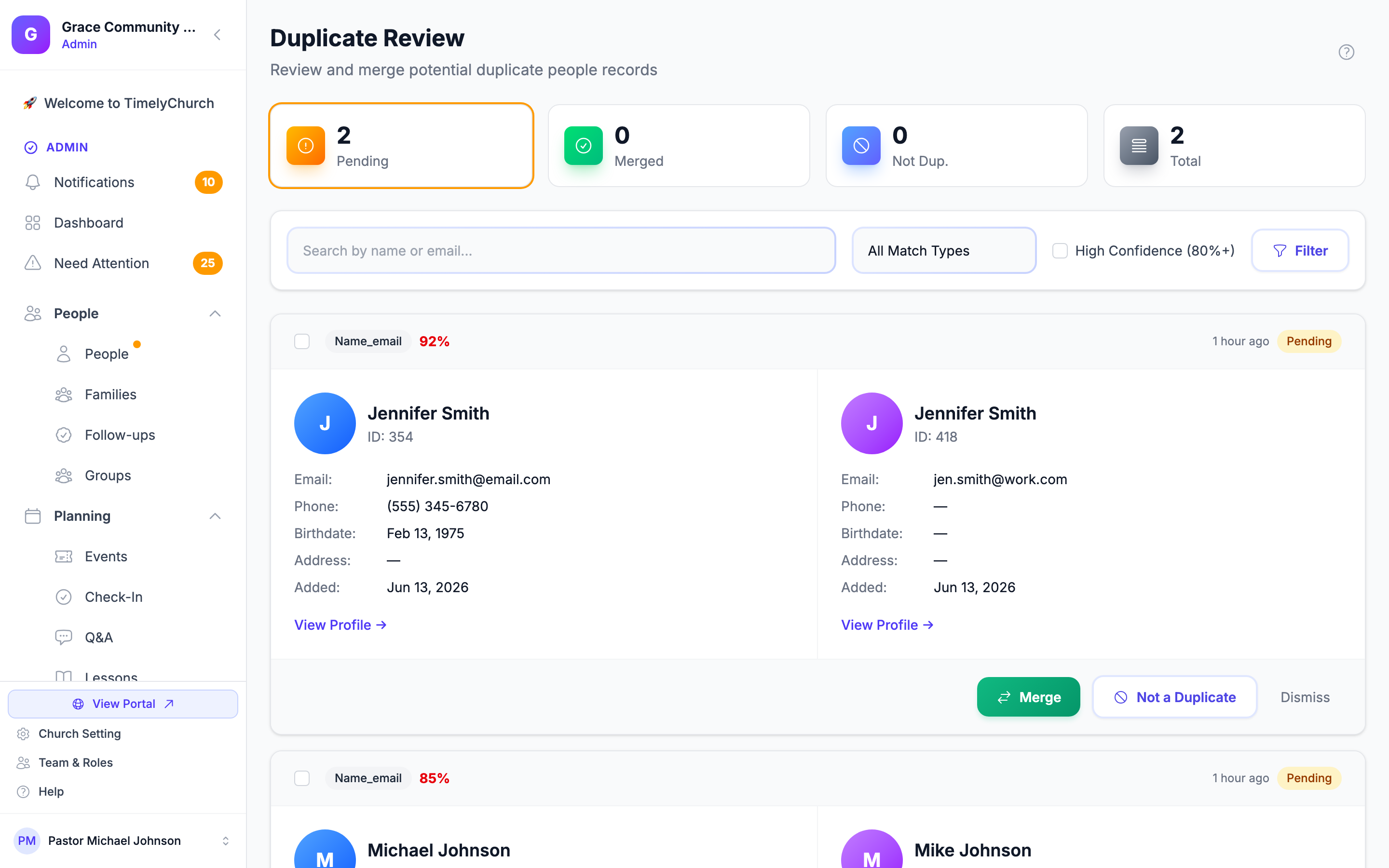
Dashboard Statistics
At the top of the page, you will see counts for:
- Pending -- Duplicate pairs waiting for your review
- Merged -- Pairs that have been merged
- Not Duplicate -- Pairs you confirmed are separate people
- Dismissed -- Pairs you dismissed without taking action
Filtering Duplicates
You can filter the duplicate list by:
- Status -- Pending, Merged, Not Duplicate, Dismissed, or All
- Match Type -- The kind of match that was detected
- High Confidence -- Show only duplicates with a confidence score of 80% or above
- Search -- Search by name or email
Reviewing a Duplicate Pair
For each potential duplicate, you will see both records displayed side by side, including:
- Names
- Email addresses
- Phone numbers
- Membership status
You have three options for each pair:
Option 1: Merge
If the two records are the same person, merge them into one:
- Click Merge.
- Choose which record to keep (Person A or Person B).
- Optionally add notes explaining the merge.
- Click Confirm Merge.
When you merge:
- The record you keep becomes the primary profile.
- Family memberships from the secondary record are transferred to the primary.
- Notes are moved to the primary profile.
- Follow-ups are moved to the primary profile.
- Form submissions are moved to the primary profile.
- Missing contact info from the secondary record fills in any blank fields on the primary (email, phone, address, birthdate, gender, etc.).
- The secondary record is deactivated and soft-deleted (archived).
Option 2: Not a Duplicate
If the two records are genuinely different people (for example, a father and son with the same name):
- Click Not a Duplicate.
- Optionally add a note explaining why.
- Click Confirm.
This removes the pair from your pending list and prevents it from being flagged again.
Option 3: Dismiss
If you are unsure or want to deal with it later:
- Click Dismiss.
- Optionally add a note.
Dismissed pairs are moved out of the pending list.
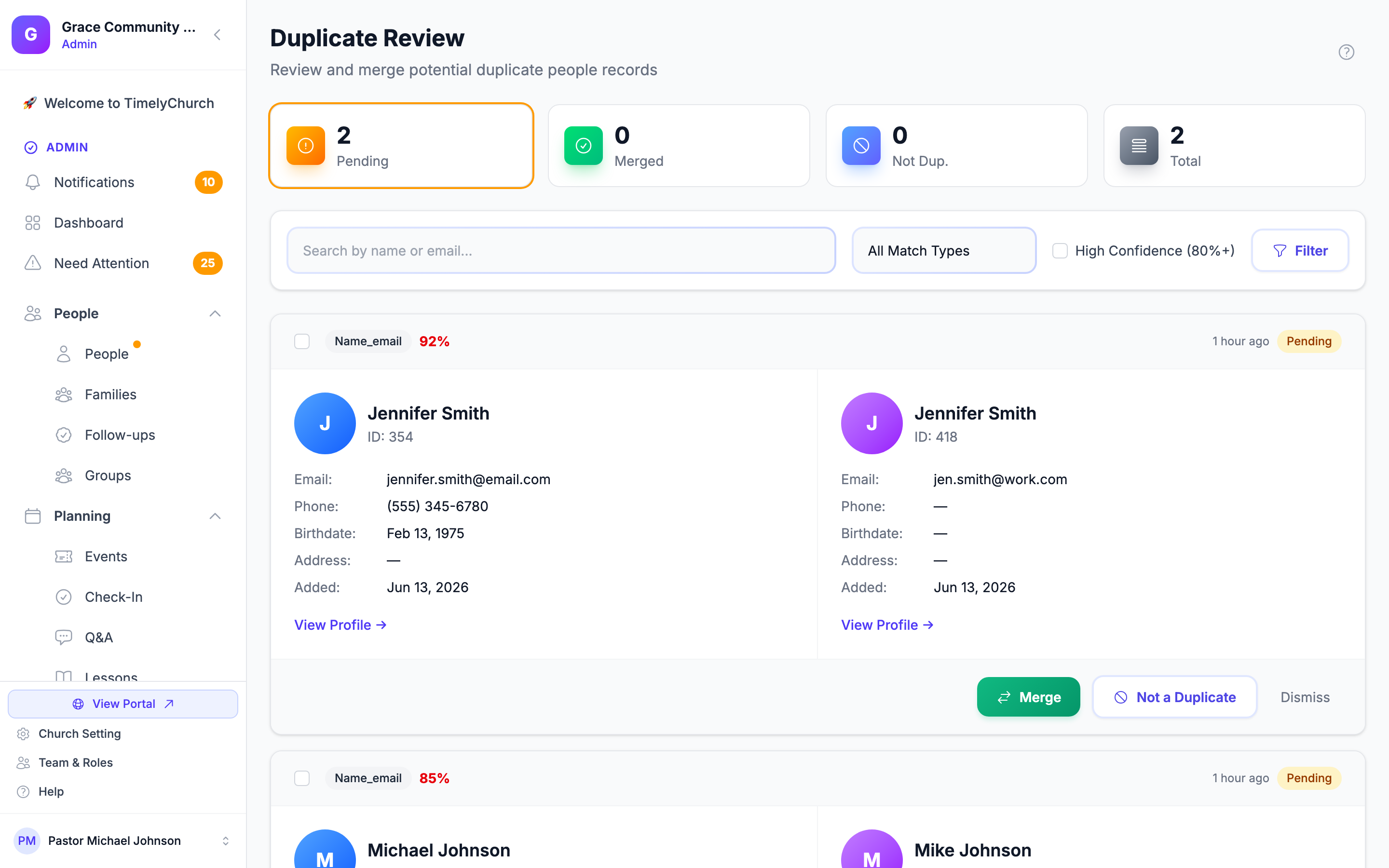
Tip: Start with high-confidence duplicates (80%+). These are almost always actual duplicates and can be resolved quickly.
Advanced Merge from a Person's Profile
You can also initiate a merge directly from any person's profile for situations where you know who the duplicate is:
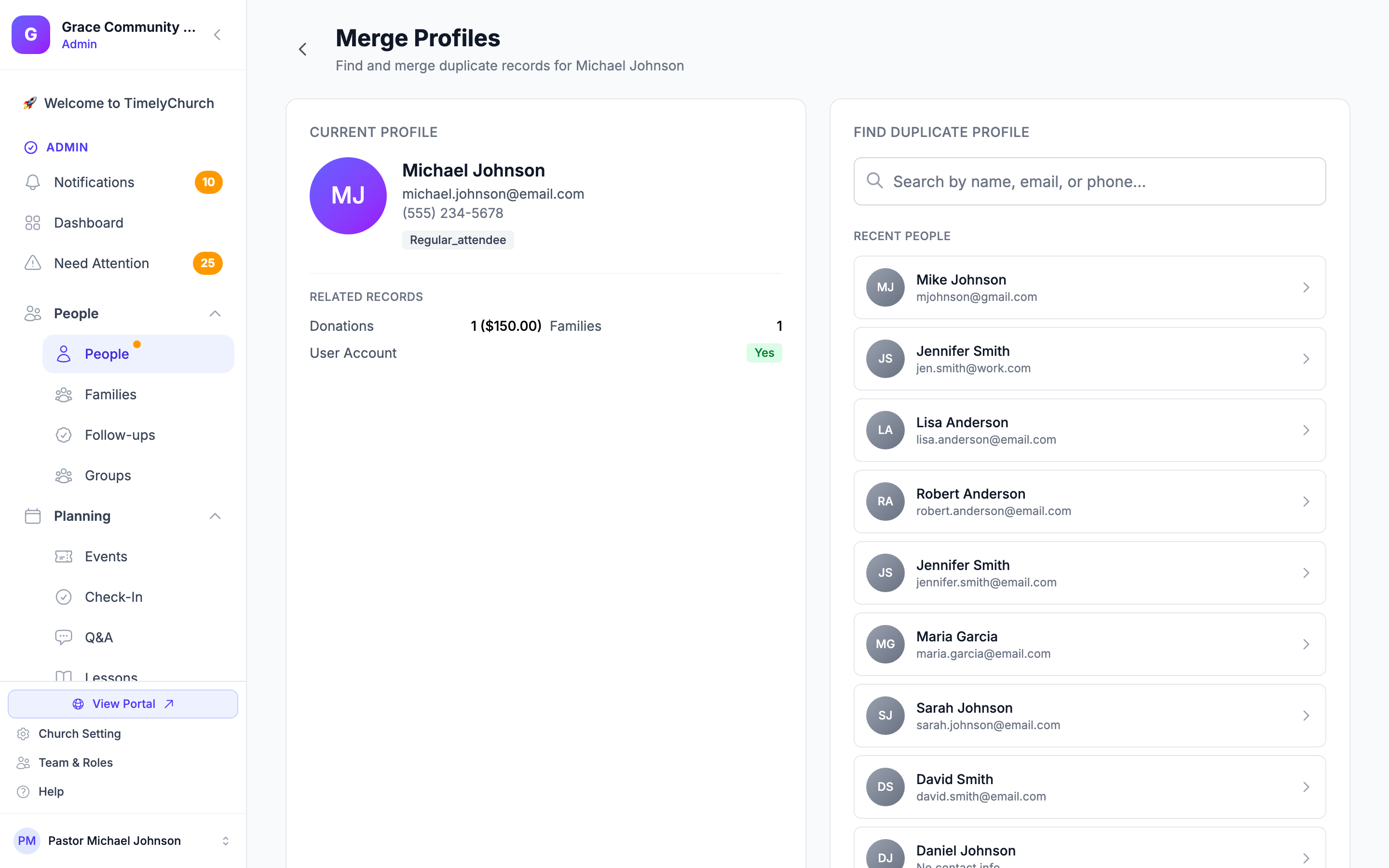
Step 1: Search for the Duplicate
- Open the person's profile.
- From the Actions menu, select Merge with Another Person.
- A search page will appear. Type the name, email, or phone number of the person you want to merge with.
- Select the matching record from the search results.
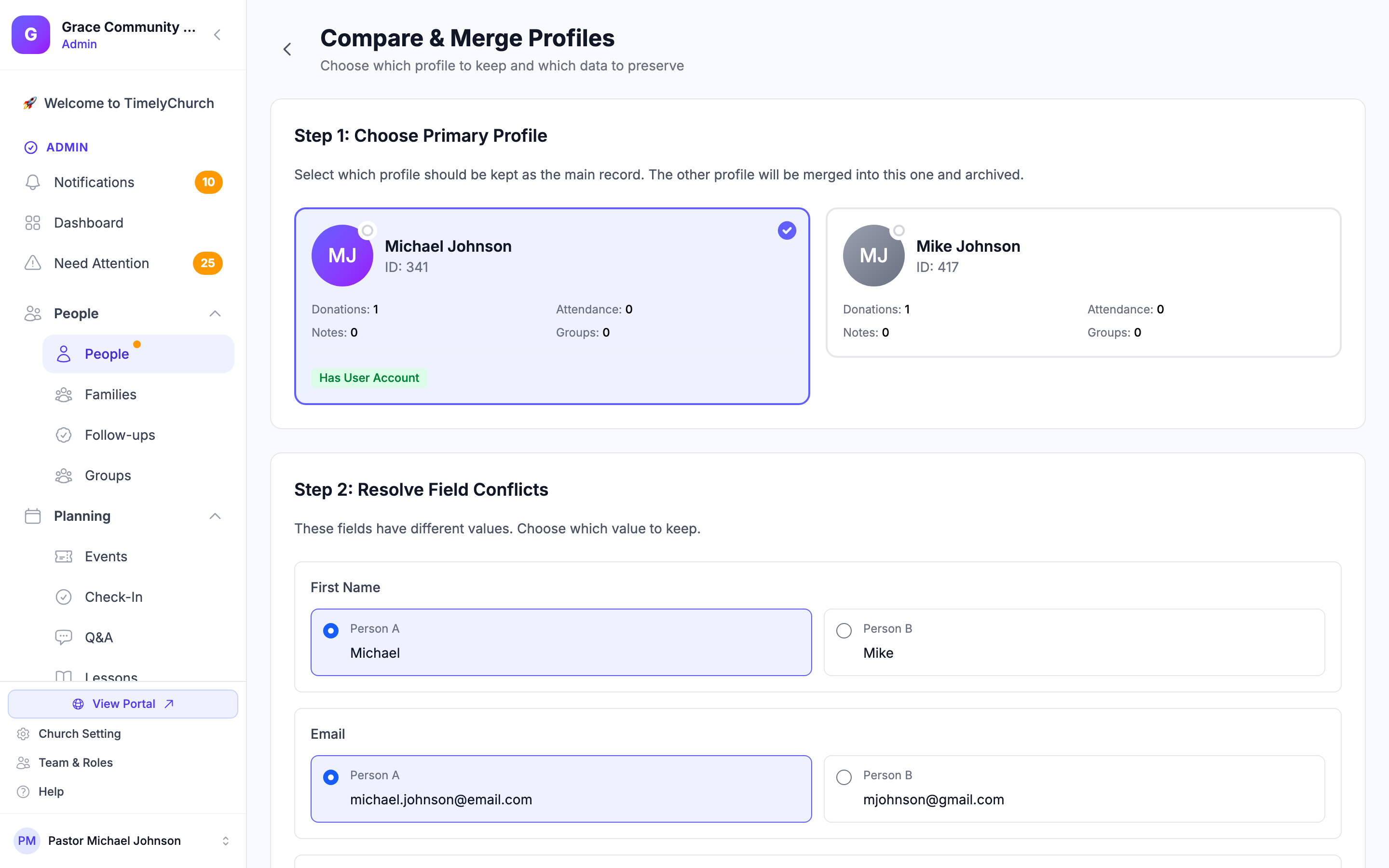
Step 2: Compare Side by Side
- After selecting the second person, a detailed comparison page will appear.
- For each field (first name, last name, email, phone, address, etc.), you will see the values from both records.
- Choose which value to keep for each field by selecting Primary or Secondary.
- You can also choose values for custom fields.
Step 3: Confirm and Execute
- Review your choices carefully.
- Choose which record is the Primary (the one that will be kept).
- Type the name of the secondary person (the one that will be archived) to confirm.
- Optionally add notes explaining why the merge was performed.
- Click Merge.
After the merge:
- You will be redirected to the primary person's profile.
- A success message will show what was transferred (notes, follow-ups, family memberships, etc.).
- The secondary person is archived.
Tip: The confirmation step (typing the secondary person's name) is a safety measure to prevent accidental merges. Take a moment to double-check before confirming.
Merge History
TimelyChurch keeps a log of all merges:
- Navigate to People > Merge History.
- You will see a list of all past merges, including:
- Who was merged into whom
- Which team member performed the merge
- When the merge happened
This audit trail is useful for accountability and for tracking down issues if you ever need to understand how records were combined.
Bulk Actions for Duplicates
When you have many potential duplicates to review, you can use bulk actions to speed up the process:
- Bulk Mark as Not Duplicate -- Select multiple pairs and mark them all as not duplicates at once.
- Bulk Dismiss -- Select multiple pairs and dismiss them all at once.
- On the Duplicate Review page, select the checkboxes next to the pairs you want to act on.
- Click Mark Not Duplicate or Dismiss from the bulk action toolbar.
Preventing Duplicates
The best strategy is to prevent duplicates from being created in the first place:
- Use the Skip Duplicates option when importing -- This is enabled by default and checks for matching names and emails before creating new records.
- Search before adding -- When manually adding someone, TimelyChurch will warn you if a similar record already exists.
- Standardize data entry -- Encourage staff to use full legal names (not nicknames) as the first name, and use the nickname field for informal names.
- Review duplicates regularly -- Check the Duplicate Review page weekly or monthly to catch any that slip through.