
Room Capacity and Live Occupancy
The Rooms view on the Check-In Station shows, for every class in your children's ministry, how many people are currently checked in. It is the fastest way for a children's ministry leader to see how full each classroom is during a service -- before a room becomes a fire-code or child-safety problem.
This article explains how to set up rooms with capacity, how to read the live Rooms view, and what to do when a room hits its limit.
Note on this feature: TimelyChurch tracks room capacity and computes a live occupancy percentage behind the scenes. Today the Check-In Station surfaces the live head count per class (the List / Rooms toggle on the "Checked In" card). A standalone occupancy dashboard with capacity bars and color coding is not yet exposed in the interface. Where this article describes capacity percentages and color thresholds, treat them as the values the system tracks -- and as guidance for reading the head counts against the capacities you set on each room.
How Rooms Connect to Check-In
The data flows through three objects:
- Room -- A physical location in your facility (e.g., "Room 204 - Kindergarten"). Rooms have a name, a capacity number, and an active flag.
- Group (class) -- A class, such as "Kindergarten." Each class-type group can have one assigned room.
- Check-In -- When a child is checked in, the check-in record is linked to a class, which is linked to a room.
For each active class group with an active assigned room, the system computes:
- Currently checked in -- Children in this group who are not yet checked out, today.
- Volunteer count -- Volunteers checked into the same group, not yet checked out, today.
- Capacity -- The capacity number on the assigned room.
- Occupancy percentage -- (Currently checked in) divided by (capacity), as a percentage.
When sorted, rooms appear fullest first.
Setting Up Capacity
Before capacity numbers can mean anything, your rooms need them.
1. Set Capacity on Each Room
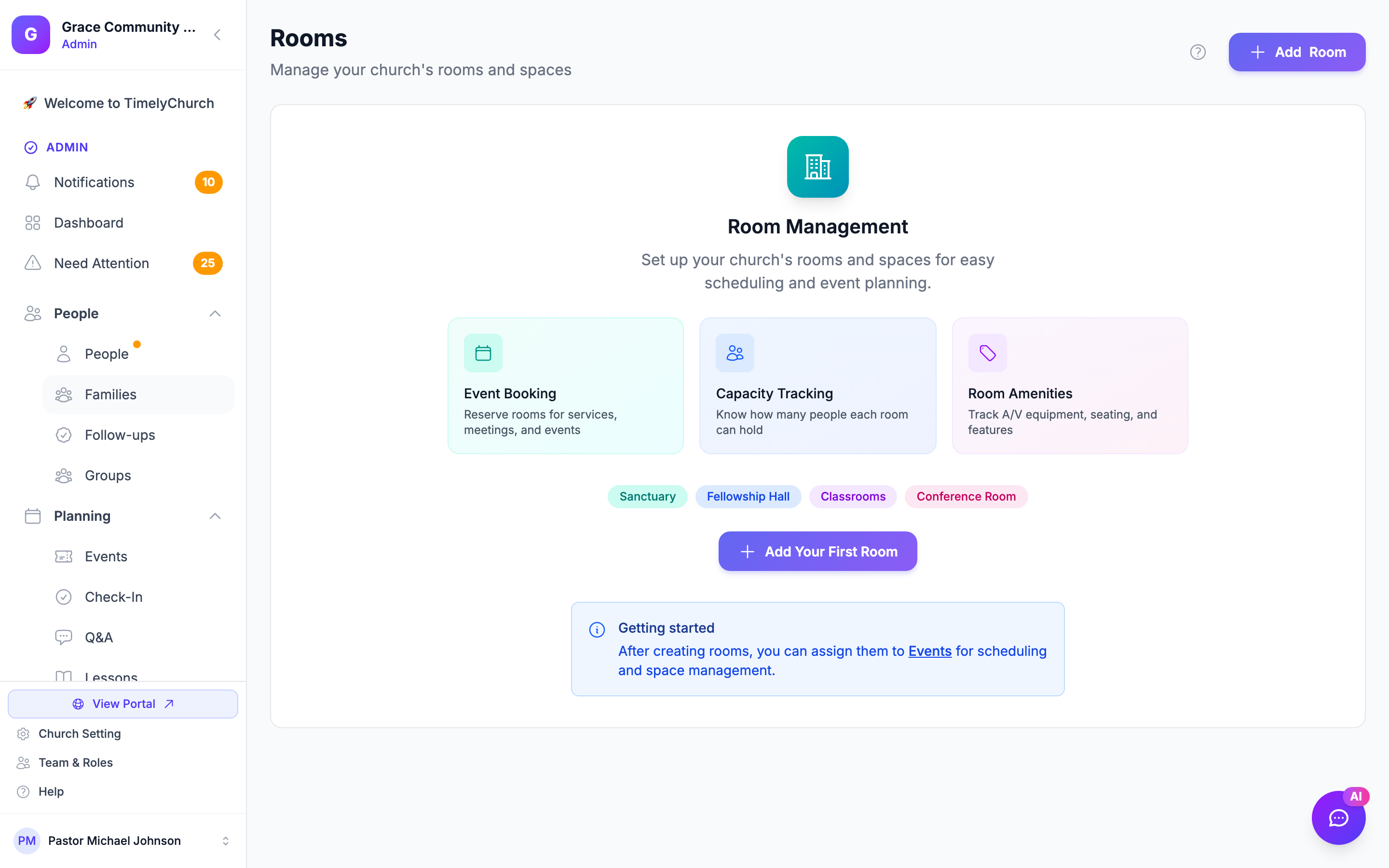
- In the left sidebar, open Facilities > Rooms.
- Open a room (or click Add Room to create one).
- Enter a number in the Capacity field. This should reflect the maximum safe occupancy -- typically dictated by your fire code, your insurance carrier, or your child-to-adult ratio targets.
- Confirm the Active checkbox is ticked.
- Save.
Repeat for every room used in children's ministry.
2. Assign Each Class to a Room
- In the left sidebar, open Groups.
- Open a class-type group (e.g., "Kindergarten"), or create one.
- In the Room Assignment dropdown, select the room you want this class to use (the dropdown lists each room with its capacity). Leaving it on No room assigned means the class has no tracked location.
- Save.
3. Verify
On the Check-In Station, open the Checked In card and switch to the Rooms view. You will see one section per active class. Once children check in, their counts appear under the matching class.
Note: A class with no room assigned still appears in the Rooms view by name, but it has no capacity to measure against. A check-in with no class at all lands in the No Room section (see below).
Reading the Rooms View
On the Check-In Station, the Checked In card has two views, toggled at the top right:
- List -- a flat list of everyone currently checked in, with their time, class, security code, and a checkout button.
- Rooms -- the same check-ins grouped by class, one section per class.
In the Rooms view, each class section shows:
| Element | Meaning |
|---|---|
| Class name | The class or group (e.g., "Kindergarten"). |
| Head count | Live count of children currently checked into this class. |
| Each child | Name, age, check-in time, security code, allergy/medical flags, and an Out button. |
The capacity you set on the assigned room is the number to read this head count against. (The capacity number and an occupancy percentage are tracked by the system but are not displayed on this view in the current build.)
Color and Indicator Conventions
The system tracks occupancy as a percentage of capacity. As a rule of thumb for reading the head counts yourself:
- Under 70 percent of capacity -- Plenty of room; no concern.
- 70-90 percent -- Approaching capacity; monitor.
- 90+ percent -- At or over capacity; intervene now.
Color-coded capacity bars are not surfaced in the current interface, so compare the head count to the room's capacity number directly.
"No Room" Children
Sometimes a child is checked in without a class assigned. These children are not lost -- they appear in the No Room section at the bottom of the Rooms view, with a warning indicator and a "need assignment" count.
To fix:
- Identify which check-ins are missing a class.
- Make sure the child is checked into a class going forward (and that the class has a room assigned per the setup steps above).
This is a common situation when a new class is added mid-year and check-in volunteers forget to pick it, or when a walk-in is checked in without choosing a class. The No Room warning surfaces it before it causes confusion at pickup.
What to Do When a Room Hits Capacity
When a class's head count approaches or hits its room capacity, the children's ministry leader has several options:
1. Open an Overflow Class
If you have a backup classroom for the same age group, open it and start checking new arrivals into the overflow class. This is the most common response and the reason many churches keep one extra classroom configured but inactive.
2. Move Children Mid-Service
If two adjacent age groups are unbalanced -- one full, one half-empty -- consider moving a few older children up to the next age class to even out the rooms. This keeps families happy and matches volunteer-to-child ratio targets.
3. Alert the Door
Coordinate with the check-in volunteers to politely route additional families to a different age group, or to ask them to wait while overflow opens up.
4. End-of-Service Lookback
If a room hit capacity once during the service, that's a planning signal. Review your room assignments before next week. Common fixes:
- Move the class to a larger room.
- Increase the capacity number if the room can actually safely hold more (verify with fire code).
- Split the class by age range.
Capacity vs. Volunteer-to-Child Ratio
These are two different measures. Both matter.
| Measure | What it limits |
|---|---|
| Capacity | Physical / safety / fire-code limit. "How many bodies fit safely in this room?" |
| Volunteer-to-child ratio | Supervision limit. "Are there enough adults watching the children present?" |
A room can be under capacity but over ratio. For example, a 30-capacity room with 12 children and 1 volunteer is at 40 percent capacity but a 12:1 ratio -- which exceeds standard targets for that age group.
A room can also be at capacity but under ratio. For example, a 30-capacity room with 30 children and 6 volunteers is at 100 percent capacity (and you should not admit more children) even though the ratio is comfortable.
Watch both signals so you can act on either.
See article 10 for the full volunteer-to-child ratio explanation.
Live Updates
The Check-In Station refreshes as children check in and out, so head counts stay current during a service. As children are checked in or checked out, the counts update without you doing anything.
If you suspect the page is stale, reload it for a fresh pull.
Setting Capacity Without Going Over
Some churches set capacity numbers slightly below the fire-code maximum to build in a margin for visitors and walk-ins. For example, a room rated for 30 might be set to 27. The reasoning: when the room fills to 27, you still have 3 spots to absorb the inevitable late arrival without breaking the legal limit.
This is a judgment call. The trade-off is between cushion and apparent capacity utilization. Whichever number you choose, document it in your church's children's ministry policy so volunteers know what "full" means.
Frequently Asked Questions
Why isn't this class showing a head count? Confirm: (1) the group is class-type, (2) the group is active, and (3) children are actually checked into it. A class with no room assigned still appears by name, but it has no capacity to measure against -- assign a room (and make sure that room is active) so the capacity is tracked.
Can I have two classes share one room? Technically yes -- two class-type groups can both link to the same room. Each class shows its own head count, but they both reference the same capacity number, which can be confusing if the room is genuinely shared. Best practice: one class per room, or rethink whether they should be one combined class.
Does the count include children who have already been picked up? No. The head count only counts active check-ins (not yet checked out). Once a child is picked up, the count decreases.
Are visitor / walk-in check-ins included? Yes, as long as they are checked into a class. Visitor check-ins go into the children's class just like everyone else.
What happens if a room's capacity is unset? The head count still shows, but there is no capacity to measure it against, so no occupancy percentage can be computed. Add a capacity to the room to make occupancy tracking meaningful.
Related Articles
- Check-In Settings -- Where rooms and classes are configured.
- Volunteer Check-In -- The companion volunteer-to-child ratio.
- Unclaimed Children -- End-of-service safety dashboard.